
Founder's Story

I left school at 16 with no qualifications.
On paper, that is not the sort of start that suggests a future in product design, engineering or business. But paper never told the full story. Long before I ever had a job, I was curious about how things worked, how things were made, and how they could be improved. That curiosity shaped my life far more than any exam result ever did.
As a child, I spent a lot of time with my grandparents, who lived near the Bowers & Wilkins factory in Worthing on the south coast of England. My granddad had a huge influence on me. Whenever I went round there, he always seemed to have something for me to take apart. I can still remember record players, vacuum cleaners and washing machines being dismantled and spread out in pieces, then put back together again while he explained how everything worked. Looking back, those were my first real engineering lessons. I did not know it at the time, but that hands-on way of learning stayed with me for life.

One of my earliest memories of solving a practical problem came when I was about nine years old.
My father worked as a dairy manager and had to be available if the alarm went off at work, day or night. We had a phone in the house, which was not especially common then, but it was downstairs and the bedrooms were upstairs. If it rang in the middle of the night, there was every chance nobody would hear it. So, using what I had learned from my granddad, I ran a cable up the outside of the house and installed an extension upstairs. Within about an hour, the problem was solved. That probably says a lot about me in hindsight. I have always been drawn to practical solutions, especially when something clearly could work better than it did.
Around the same time, I became completely obsessed with music. But it was never just the music itself. I was fascinated by the equipment too. I wanted to know how sound was created, how systems were put together, and why some things sounded so much better than others.
That curiosity led me, quite literally, to the bins outside Bowers & Wilkins.
A friend of mine, who was about three years older than me, first took me there and showed me what was possible. Bowers & Wilkins had three factories at the time, and over a period of weeks we would go from one to another two or three times a week looking for usable parts that had been thrown out. Bit by bit, we found everything we needed. He taught me how to build speakers, and the speakers we built were a pair of B&W DM220s with stands.

That story sounds slightly unbelievable now, but it is true.
One memory from that time has stayed with me ever since. On one occasion, John Bowers himself pulled up in his sky-blue Porsche 911 Targa and asked, “What are you doing, lads?” We told him we were collecting parts to build speakers. He said we could help ourselves to anything we found. That proved extremely useful later on whenever other members of staff tried to chase us away, because we could honestly say that the bloke with the Porsche had told us it was fine.
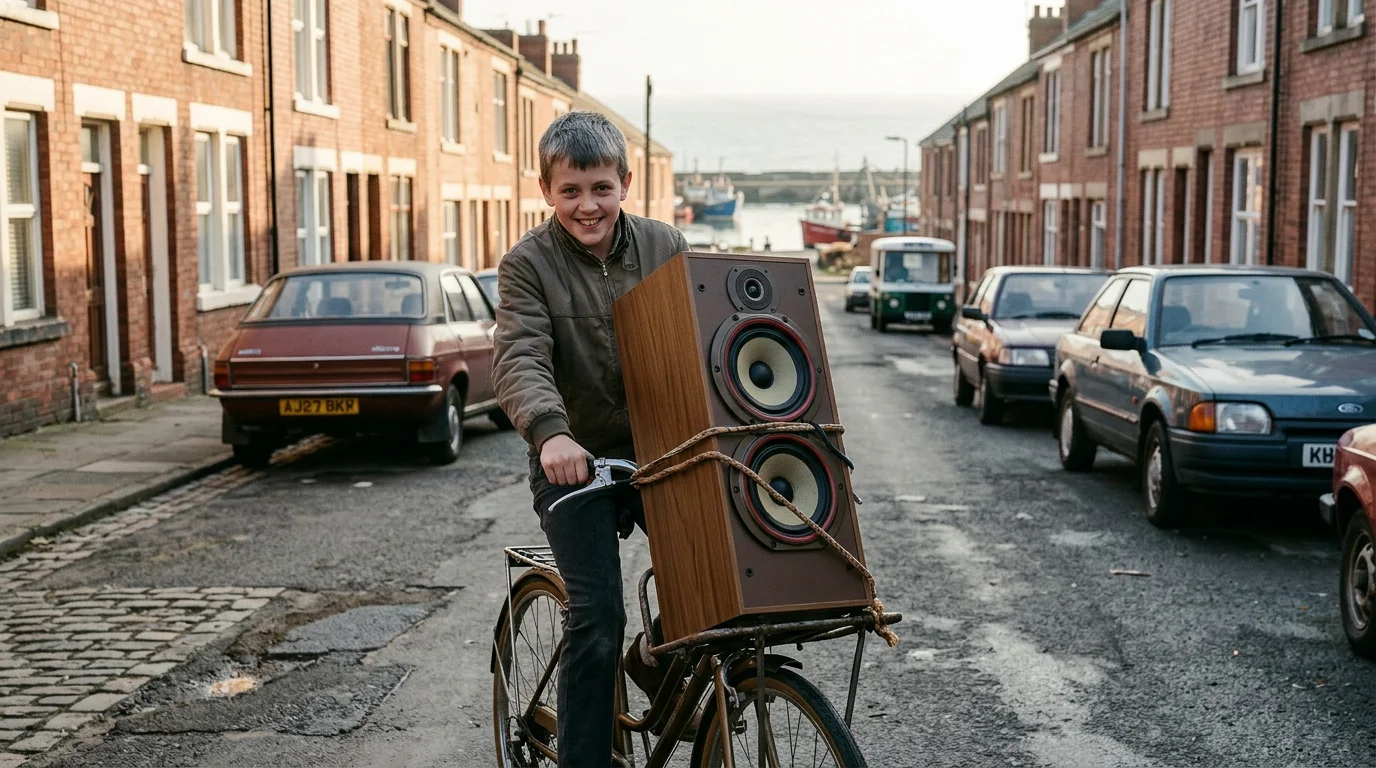
Those first speakers meant a lot to me, not just because they were Bowers & Wilkins speakers, but because I had helped build them. They were not small speakers either. They were proper three-way speakers, around 800mm tall, and with the stands they stood at about a metre high. Somehow, I managed to carry them home on the handlebars of my bike. I still do not quite know how I pulled that off.
My first hi-fi system came together the same way:
Piece by piece, through curiosity, effort and whatever I could afford. My first record deck (turntable) was a second-hand Pioneer from a used shop. I paired it with a valve amp (tube amp) from a jumble sale (flea market), and some wire rescued from an electronics shop’s bin finished the system off. It was all cobbled together, but to me it was brilliant. I valued it because I had found it, built it, and made it work.

Then, on 16 August 1986, something happened that changed my life.
Through my grandmother, who worked at Bowers & Wilkins as the tea lady, I got the chance to start there on the production line. The company had a backlog of orders and I was taken on for what was initially meant to be a three-month trial. It is strange to think about now: after building Bowers & Wilkins speakers from parts rescued from their bins as a kid, I ended up walking through the doors as an employee and learning how to build them for real.
I took that opportunity seriously from day one. I worked hard, learned quickly and made myself useful. I was earning my own money for the first time, and I still remember some of the things that mattered to me then. In the first few weeks of working there, I bought a huge Pioneer ghetto blaster (boombox). Around that same period, I also bought my first CD player. I had seen one featured on the BBC programme Tomorrow’s World about a year or so earlier and desperately wanted one. At the time, compact discs still felt futuristic. I bought the CD player from a catalogue, paying for it weekly or monthly, though I cannot remember exactly which. What I do remember very clearly is the first CD I bought for it: Brothers in Arms by Dire Straits. There were not many CDs available then, which is funny to think about now that CDs themselves have largely been replaced by streaming.
What started as a three-month trial turned into a 29-year career.

Over those 29 years at Bowers & Wilkins,
I worked my way through a wide range of roles across the company. I worked in production, warehousing, engineering, quality control and purchasing, spending roughly 18 years of that time in purchasing-related roles. I was fortunate to have some very good bosses who recognised early on that I was far more capable than my school results suggested. Only later in life did I discover that I am very dyslexic. I do not see that as a weakness. In many ways, I see it as a strength. I believe it helps me visualise products, understand how things go together, and solve problems in a different way. It has played a big part in how I think about design.
As I progressed through the business, I was lucky enough to be involved in increasingly senior and high-level discussions. I spent a lot of time in meetings about new products, many of which had not even launched yet. These were discussions not just about what a product should do, but how it should look, how it should feel, how it should be made, and how it should sit alongside other products in a range. I learned that great product design is never accidental. The best products are thought through properly, right down to the smallest details.
I also worked with top-level design houses, the sort of people who looked exactly as you might imagine: eccentric, modern, sometimes turning up in bright orange suits and the most futuristic glasses you had ever seen. Brilliant people, but often a pain in the arse as well. They had a vision, and that was what they wanted. My job in sourcing was to get as close as possible to that vision at the best possible value. Quite often, they would design something that simply could not be made as drawn, or at least not easily. I suspect part of the reason was that they were deliberately pushing the envelope. They were trying to force the company to think bigger, design better and be more ambitious.
That taught me a great deal.
It taught me that good products do not come from accepting the first “good enough” answer. They come from pushing, refining, challenging and finding ways to make things happen. That has stayed with me throughout my entire career. To this day, when a supplier tells me something cannot be done, I do not automatically accept it. I push back. I ask how it can be done. Because after years of working with so many materials, factories and production methods, I often have a very good sense of what is actually possible, sometimes even better than the factory does itself.
That mindset affects every level of the products we create. It is not just about appearance. It is about how parts fit together, how the product assembles, how it feels in the hand, how the packaging works, how the finish looks under real light, how the tolerances behave in production, and how the customer experiences the product from the moment they open the box. Every single detail matters, and every single detail is thought about before we go into production.

My final role at Bowers & Wilkins took me to Asia,
where I was effectively working as a supply chain manager. That role pulled together everything I had learned over the years. I worked directly with suppliers, managed new product development, dealt with value engineering, design for manufacture, lean manufacturing, material choices, cost targets and all the processes needed to make products as close to perfect as possible. I loved that role. It gave me a deep understanding not just of audio, but of how great products are brought into existence in the real world.
By the time I left Bowers & Wilkins in 2015, I had a head full of product ideas.
The problem was that they were trapped in my head.
I could visualise how I wanted products to look, how I wanted them to work, how they should fit together and how they should feel. But inside a big company, many of the things needed to turn an idea into a real product had always come from different departments. Drawings, finish specifications, gloss levels, Pantone references, tolerances and technical details were all there within the business. I had worked with them for years, but I had not needed to generate every one of them myself from scratch.
Suddenly, that support structure was gone.
Within the first few weeks of leaving, I found myself having to teach myself the missing parts of the process so I could turn the products in my head into something real. I began learning CAD so I could sketch products and explain clearly to factories how I wanted them made. I was researching finishes, buying Pantone books and gloss references, working through design tolerances, talking to factories about materials, and learning how different plastics and metals needed to be designed so that parts would fit together properly in production. The knowledge was already there in my head, but now I had to build the full system around it myself.

That was a huge turning point.
It was the moment where years of experience stopped being experience inside somebody else’s company and became the foundation of my own.
That is where Soundbass really began.
The first product I designed was a carry case for a Bose speaker. It was a simple product, but I wanted it to be the best case on the market. At the time, there were already plenty of Chinese factories making cases for the Bose Colour speaker, but most of them were generic, usually black, and clearly designed to be “good enough” rather than genuinely good.
I wanted something better. The speaker itself came in five different colours, so to me it seemed obvious that the case should be available in matching colours too. I wanted the fit to be perfect. I wanted memory foam inside for proper protection. I wanted YKK zips so the quality felt right. I wanted a neat little pocket for leads and accessories so everything had its place. It was a simple product, but every detail mattered.
What mattered even more was that it was completely designed by me. It was one of the first times I had taken an idea in my head and pushed the whole product through myself, from concept to specification to finished product.
I ordered 1,000 pieces from the factory and sent them into Amazon. Within three weeks, they had all sold out. Then we had to wait another three or four months for more stock, which was painful at the time, but it proved something important very quickly: if you create a product properly, there is real demand for it.

That first success gave me confidence,
but cases were never the end goal. What I really wanted to design was wall mounts and floor stands. I had chosen Bose and Sonos very deliberately. During my years in Asia, I had visited factories making parts for many different audio brands, and I had developed a strong sense of which companies were producing at real scale. Compared with more specialist audio brands, Sonos and Bose were operating in far greater volumes, and that made them a much stronger foundation for an accessories business. The thinking was simple: if you are going to design accessories, you need to attach yourself to products that already have a large and growing customer base.
That strategy became the foundation of Soundbass.
Soundbass was built on a simple idea: create accessories that genuinely improve the products people already love. Not gimmicks. Not pointless add-ons. Not products that look nice in a photo but disappoint in real life. Properly thought-through accessories that solve real problems, improve performance, fit naturally into people’s homes, assemble properly, feel right, and offer genuine value for money.

Everything we do at Soundbass comes from the same mindset that has followed me through life:
Understand how it works, understand where it falls short, and then build something better.
That applies to everything. The way the product fits together. The quality of the finish. The strength of the materials. The tolerances. The way it mounts. The way it is packed. The way it is presented. The way the customer experiences it from the moment they open the box. I push suppliers hard. I question everything. I do not like corners being cut, and I do not accept “that will do” as a standard. That approach runs right through the business.
As Soundbass reaches its 10th anniversary, I look back on my years at Bowers & Wilkins as the university I never had. I did not learn in a classroom. I learned by doing, by listening, by making mistakes, by solving problems, by working alongside talented people, and by spending nearly three decades inside one of Britain’s most respected audio companies.
I am incredibly proud of what we have achieved with Soundbass. We are still not a huge company, and that is absolutely fine. What matters to me is that we are a company built on passion, drive and a genuine desire to make great products properly. Every day, I strive to make Soundbass as good as Bowers & Wilkins was in the areas that matter most to me: quality, customer service and design.
For me, Soundbass is not just a business.
It is the result of a lifetime spent learning how things work, how they can be improved, and how good engineering, thoughtful design and genuine care can make a real difference.
And in many ways, it all started with a curious kid, a very helpful granddad, and a few speaker parts rescued from a bin.

Get in touch
If you’re interested in contacting Soundbass to learn more about sound or just want to see what we have available right now then please send us an email



 English (United States)
  English (UK)
  English (Canada)
  German
  French
  Dutch
Dutch  Spanish
  Italian
  English (Australia)
